For years I've been reading that this engine was canted over at thirty degrees to lower bonnet lines...
Some put forth the idea that the engineers were also harking back to a 60° V12 they'd built during the war and its characteristics.
People actually get quite incensed when I point out that the highest part of the engine is the carburettor, and that gets even higher than it might otherwise be because of the canting of the engine.
Reasons I've read for the lean are many and varied, but principally:
1. to reduce height
2. to give room for better fuel distribution and torque characteristics with all that room for a manifold
3. to enable the water pump to be offset and thus not add so much length to the engine
4. to lower the centre of gravity
There can be no doubt as to the validity of points 2 and 3. The inlet manifold did take advantage of the additional space while the space saving of the water pump did help on an engine which already had restricted bore sizes with a view to keeping the length down.
Oh, yes, that was a designed-in detail that led immediately to raising the block an inch to enable the engine to be stroked from 170 to 225 cubic inches.
I'd like to look at this calmly and logically, ignoring anything that might be 'spin' and see what logic can draw up on it. The first thing I usually do is go to cutaway drawings of the engine front-on, which I gleaned from a website which appears not to exist any more:
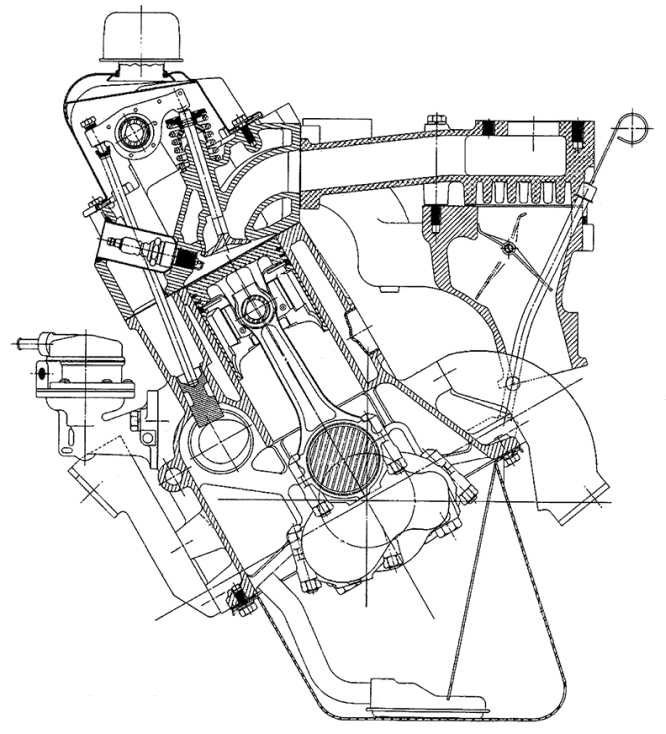
Taking measurements the best I can, this is the 170 version. Then I tilted it back to vertical and put the two side by side, using the necessarily fixed point of the crank centreline as my datum line and I get this:
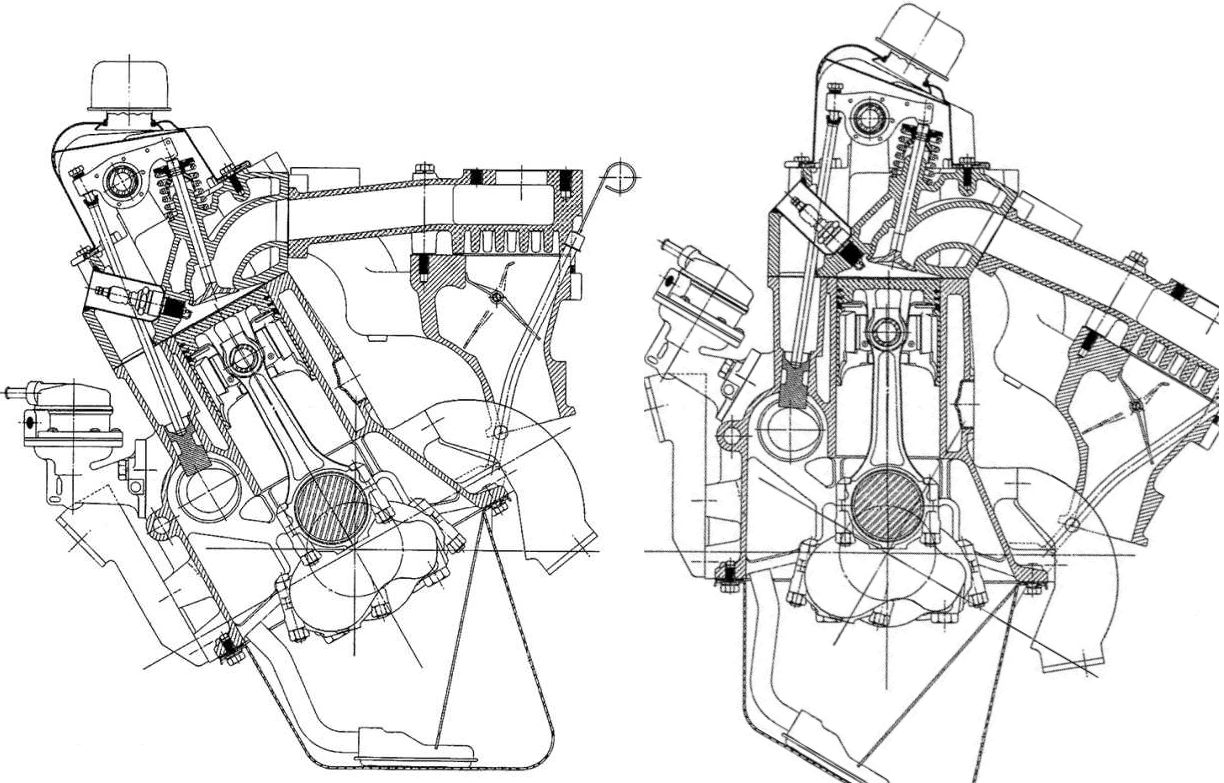
As can be seen, 30° doesn't make a big difference to height. After all, the carburettor and air cleaner have to be added to this, and they will obviously be higher. Higher, in fact, in the slanted position than they could be made with the engine vertical. In fact, if the head design remained the inlet ports would be lower.
The actual height above the crank centre line (to the top of the rocker cover) is 16.75" while the original sits at 14.1". With an inch or maybe more possible to be pared off the top of the rocker cover if it were shaped to suit the vertical application, the height difference is something like an inch and a half.
And they happily added an inch to the deck height when they went to the 225...
What I would like to see is a cutaway of the early Valiant showing the engine's true position within the body.



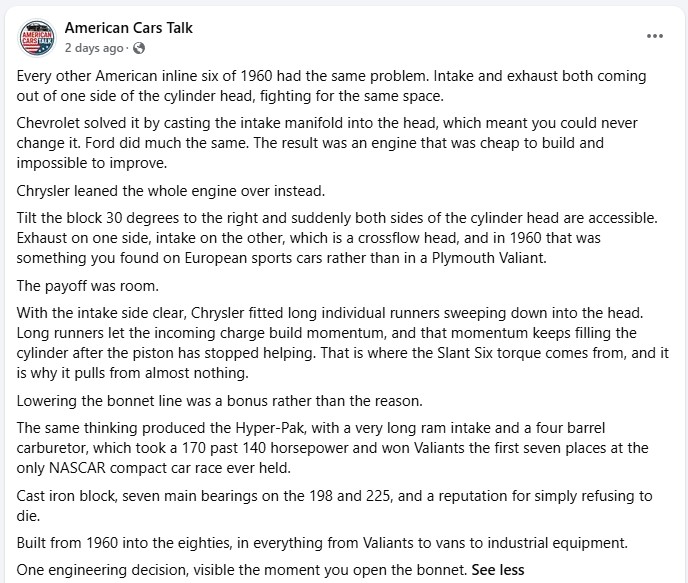
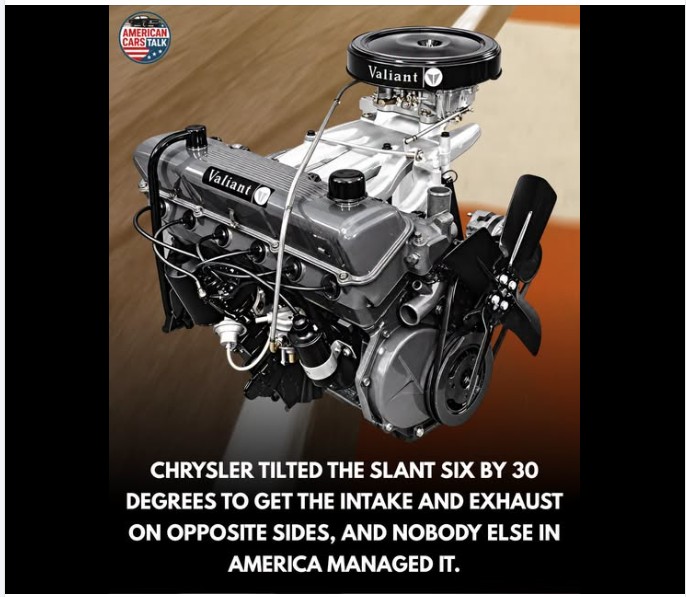
 One problem with AI is that it has no eyes. One look at a Slant Six shows it has absolutely no iteration of a crossflow head. Reverse-flow Inlet & exhaust are along the same side of the head, just like the reverse flow Ford & GM sixes. As seen in the included AI-supplied image featuring text indicating a crossflow configuration that "nobody else in America managed". Except on all those overhead valve V8s, I guess.